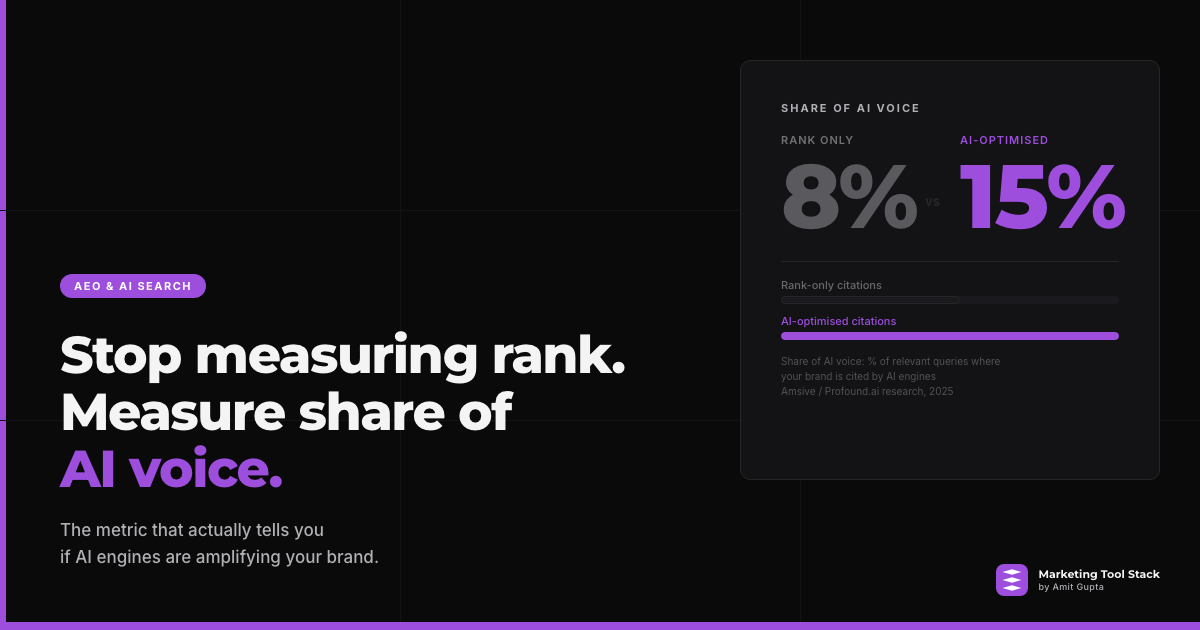

When Google shows an AI summary, people click a traditional result on 8% of searches. When there is no summary, they click on 15%. That is roughly half the clicks gone on the queries where the answer engine speaks first. So if the click is no longer the signal, what do you put on the dashboard instead?
I argued the first half of this in the last post: AI summaries cut clicks about in half, and the schema everyone is selling does not buy them back. That post ended on a metric I named in passing and never unpacked. This one unpacks it.
The honest answer up front: this measurement category is immature. There is no GA4 report for it, and a lot of the tools selling it are a manual query wrapped in a dashboard. I will say that plainly, then give you the method I actually use.
The Pew numbers are not a blip
The figures come from Pew Research Center, not a vendor pull quote. Pew tracked the real browsing of 900 US adults across 68,879 Google queries in March 2025, 12,593 of which triggered an AI summary. Published July 22, 2025, here is what they found.
With an AI summary on the page, users clicked a traditional result 8% of the time. Without one, 15%. The links inside the summary itself got clicked on 1% of results. And users ended their session on 26% of pages that showed a summary, versus 16% of standard results pages. The box answers the question, and the session is over.
Treat those four numbers as one finding. The result page now answers the buyer in place, more often than it sends them anywhere. Click-through rate was the metric built for a page that routed traffic out. The page stopped doing that on a large share of queries. So the metric stopped measuring the thing you care about. That is not a tracking problem you fix with a cleaner UTM. It is the wrong yardstick for the new shape of the page.
Rank was always a proxy. Citations are the new one.
Here is the part nobody likes to say out loud. Position one was never the thing you wanted. It was a proxy for the thing you wanted, which was to be the answer the buyer trusted at the moment they were deciding. Rank correlated with that well enough for fifteen years, so we tracked rank and called it strategy.
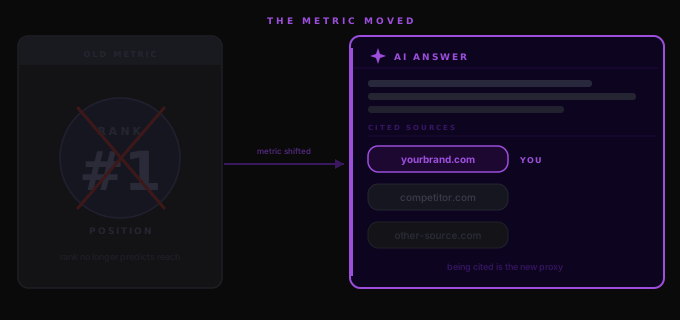
The correlation broke. A rank-tracker screenshot tells you where a blue link sits on a page the buyer increasingly does not click. A named mention of your brand inside a Perplexity answer to a real buyer question is much closer to the actual thing: you, named, at the decision moment.
So the metric has to move with the page. Stop treating "we rank third for this term" as the win. The win is "when a buyer asks the engine our category question, we get named, and ideally cited with a link." Rank was a proxy. A citation is a tighter proxy. Neither is the sale, but one of them is reading the page your buyer actually reads.
And the two can diverge hard. You can sit at position one and never get named in the AI answer, because the engine synthesized its response from three other sources it found easier to quote. You can also rank on page two and still get cited, because your one paragraph answered the question more cleanly than anyone above you. If your dashboard only shows rank, both of those cases are invisible to you, and both of them are deciding whether the buyer ever hears your name.
What share of AI voice means, and how to measure it today
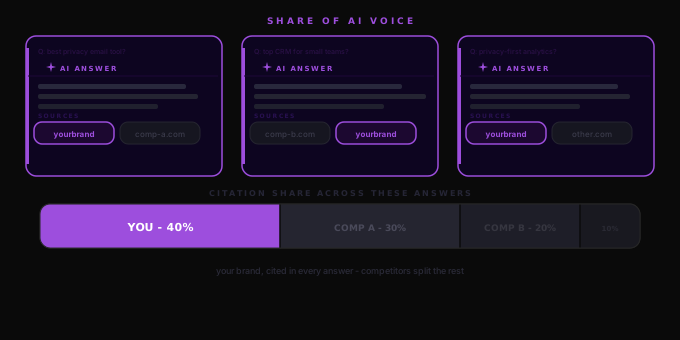
Share of AI voice is simple to define and tedious to measure, which is exactly why most teams have not started. It is the answer-engine version of share of search: of the buyer questions that matter, how often does an AI engine name you, and how often does it cite you with a link.
The method I run is manual and imperfect, and it still beats flying blind. Start with 20 to 30 real buyer-intent queries. Not your brand name, and not head terms nobody types. The actual questions a buyer asks when they are comparing or choosing: "best X for Y," "how do I solve Z," "alternatives to [competitor]." If you do not know these, your sales team does.
Run each query across the four surfaces that matter now: ChatGPT, Perplexity, Gemini, and Google AI Mode. For each one, record two things. Were you named, yes or no. Were you cited with a clickable link, yes or no. A named mention with no link still counts, because it still shapes the buyer.
Run each query at least three times. This is the step people skip, and skipping it makes the number meaningless. The same prompt produces different answers across runs, so a single check tells you almost nothing. Three runs minimum, and treat the result as a rate, not a yes or no. If you show up in two of three runs across the engines, your citation rate on that query is roughly 67%, and that is a real number you can move and re-measure.
Repeat the whole set weekly or monthly and compute a citation rate: mentions over total checks, and cited-with-link over total checks, tracked over time. That trend line is your share of AI voice. It is a spreadsheet, not a platform, and that is fine.
One thing to do before you run the set. Check whether the pages you are betting on are even built to earn a citation. Run your top pages through the SEO + AEO Content Rater, which scores direct-answer sentences, question-shaped headings, and paragraph length as a separate sub-grade from classic SEO. A page that buries its answer six paragraphs down is not going to get quoted, and measuring its citation rate just confirms the obvious slowly.
The vendor dashboard problem
A market has appeared to sell you this number, and some of it is genuinely good work. Many of the dashboards, though, are doing exactly what I described above (running manual-style queries on a schedule) and charging a subscription to render it as a chart. That is not worthless. It is just worth knowing what you are paying for.
Here is the tell, and it is one question. Ask the vendor their sampling methodology, and whether they account for answer variation across runs and prompts. A serious tool will tell you how many queries, how many runs each, which engines, how often, and how they handle the fact that outputs drift. A decorative one will give you a confident single percentage and change the subject. If they cannot explain the method, the number is decoration. A precise-looking citation share with no stated sampling behind it is marketing, not measurement.
My rule of thumb: if a vendor cannot tell you their sample size, their run count, and their refresh cadence in one sentence each, the spreadsheet you build by hand is more trustworthy than their chart, and a lot cheaper. Buy the tool when it saves you the tedium of a method you already understand, not when it hides the method from you. The point of measuring share of AI voice is to have a number you can defend in a planning meeting. A number you cannot trace is not defensible, no matter how nicely it renders.
Redefine the win, or chase a number that keeps shrinking
The counterintuitive move is this. The right response to fewer clicks is not to chase more of them. It is to redefine what counts as a win. If you keep CTR as your north star on a page that no longer routes traffic out, you will spend the year optimizing a number that structurally shrinks, and you will conclude your content is failing when it is your scorecard that is wrong.
The page that earns a citation is not a mystery. It answers a specific question directly, in the first visible sentences, with real authority behind it. That is the work. But the work only gets funded if the measurement comes first, because no team invests in a job their dashboard cannot see. Change the metric, then the content follows. Keep the old metric, and the team has no signal at all that the new work is paying off.
So here is the one I would ask in your next planning meeting: when a buyer types your hardest category question into ChatGPT today, are you in the answer, and do you have any number that tells you?
Amit