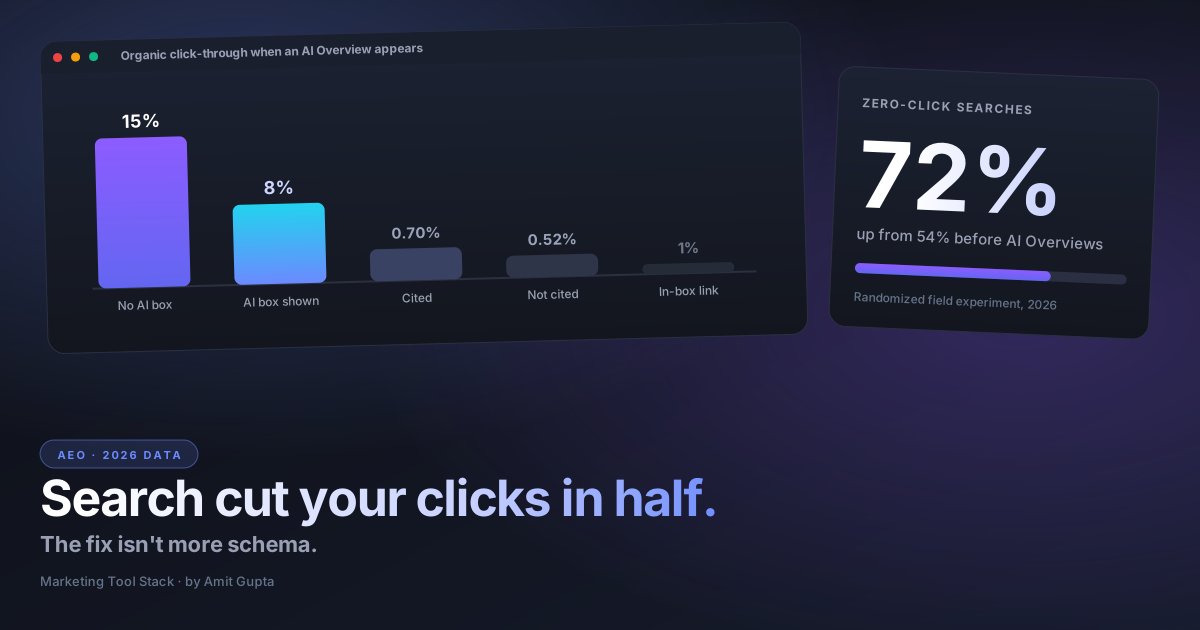
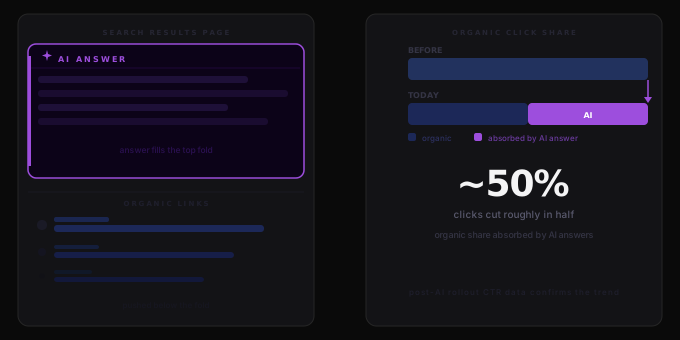
Two numbers from this year should change how you think about organic search. When Google shows an AI summary, people click a regular result on 8% of searches. When there's no summary, they click on 15%. That's roughly half the traffic, gone, on the queries where the answer engine speaks first.
I went looking for the real studies behind the AEO panic, the ones with sample sizes and methodology instead of a vendor's pull quote. Most of what I found confirmed the fear. Some of it flatly contradicted the advice people are selling to fix it. This is what held up.
The click math got worse, and now there's proof
The 8%-versus-15% figure comes from Pew Research, not a marketing agency. They watched the actual browsing behavior of 900 US adults across about 68,900 searches in March 2025. When an AI summary appeared, people clicked a traditional link on 8% of those searches. Without one, 15%. They also ended their session 26% of the time after seeing a summary, versus 16% without. And the links inside the summary itself? Clicked on 1% of visits. The box answers the question and the session is over.
For a long time you could wave that away as correlation. Maybe AI summaries just show up on queries people were never going to click anyway. That argument stopped working in early 2026. A randomized field experiment by Agarwal and Sen, published on SSRN, tested it causally on the same queries with and without summaries. Outbound clicks dropped 38%, from 0.61 to 0.38 per search. The zero-click rate on those queries jumped from 54% to 72%. This is the first causal evidence I've seen, and it lines up with what Pew measured by watching real behavior.
Seer Interactive put a number on the bleed for one slice of the market. Across 3,119 search terms and 25 million organic impressions, organic click-through on AI-Overview-heavy informational queries fell about 61%, from 1.76% in June 2024 to roughly 0.61% by September 2025. There is a wrinkle here I'll come back to, because that floor didn't hold.
Google's counterpoint, stated fairly
Google's position is that AI features grow the pie. On its own blog and again on the July 2025 earnings call, the company said AI Overviews drive a 10%-plus increase in usage for the kinds of queries where they appear, in big markets like the US and India. I'd treat that as real but self-reported. It's an internal cohort metric, not something an outside party has audited. More searches happening is not the same as more clicks reaching your site, and the click studies above are measuring the second thing.
AI Mode is not a lab experiment anymore
If you were treating AI Mode as a fringe beta, that window closed. It launched in US Search Labs in March 2025, went to all US users on May 20, 2025 with no signup and a custom Gemini 2.5 behind it, then expanded to 180 countries and territories by August 21, 2025. The conversational, answer-first surface is now the default experience for a large share of searches in most of the world.
On the ranking side, Google ran three core updates in 2025: March, June and December. The December one started on the 11th and finished on the 29th, about eighteen days of turbulence going into the new year. Nothing in the core updates rewrote the rules. The bigger shift is the result page itself changing shape.
The part the SEO blogs get wrong
Here's the finding that made me stop and re-read the source three times. The structured data markup that every AEO checklist tells you to add does not appear to help you get cited by AI.
Ahrefs ran a difference-in-differences study on 1,885 pages that added JSON-LD schema against about 4,000 that didn't, from August 2025 through March 2026. The effect on AI citations was too small to separate from noise: roughly +2.4% in Google AI Mode, +2.2% in ChatGPT, and a small but statistically significant drop of 4.6% in AI Overviews. Not a lift. If anything, a shrug.
A separate searchVIU experiment explains why. They put a product price only inside the JSON-LD, where a human reader can't see it, then asked five AI systems to read the page: ChatGPT, Claude, Perplexity, Gemini and Google AI Mode. Zero of the five pulled the price out of the hidden markup. They read the visible HTML, the same words a person sees. The machines are reading your page, not your metadata.
This matters because so much AEO advice is just SEO advice with the serial numbers filed off. Add more schema, mark up everything, win the robots. The data says the robots are reading what's on the page. Which is good news, actually. It means the work is writing clearer answers, not feeding a parser.
FAQ rich results are gone, and yes, that includes a tool of mine
Google is also pruning. Starting January 2026 it's deprecating a small set of rarely-used structured data types. The headline one for marketers: FAQ rich results. Google began restricting them to government and health sites back in 2023, and in 2026 it's finishing the job. The rich result stopped showing on May 7, 2026, Search Console reporting goes away in June, and API support ends in August.
One honest caveat, because it's my own house. This site has an FAQ Schema Generator, and it still flags answers under 40 words on the theory that short answers don't win rich results. That advice now needs an asterisk: the rich result it was optimizing for is being switched off. The FAQPage schema type itself is still valid, and structured Q&A content is still a fine way to organize a page for humans and for answer engines. You just shouldn't expect the star-studded SERP box anymore. I'd rather tell you that than let the tool quietly mislead you.
The wider point on schema, so nobody overcorrects: Google is not abandoning structured data. A Google spokesperson and John Mueller both said the 2026 deprecation is selective, aimed at low-value features, and Google even un-deprecated book actions markup in the same breath. Schema still earns you product stars, review snippets, breadcrumbs and the rest. It just isn't the lever that gets you quoted inside an AI answer.
So what actually works
The verified evidence is better at telling you what fails than handing you a guaranteed playbook. I'll be straight about that line. But the direction it points is consistent, and it happens to be the cheap, boring direction.
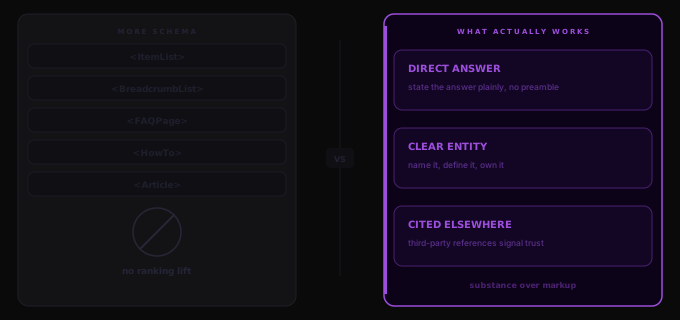
Write the answer in the first two sentences. If the machine reads visible HTML and the user never scrolls past the box, your job is to put the quotable, complete answer where both can grab it fast. Lead with the conclusion, then support it. The inverted pyramid that newspapers figured out a century ago is the right shape for an answer engine.
Use real question headings. Not because of FAQ schema, that result is dead. Because the way people query an answer engine is a full question, and matching that phrasing in a visible heading with a direct answer underneath is what gets surfaced. You can pressure-test the structure with the Blog Outline Generator and the SEO + AEO Content Rater, which scores direct-answer sentences, question headings, and paragraph length as a separate sub-grade from classic SEO.
Earn the citation, then measure whether it pays. Being cited in an AI Overview is worth chasing: Seer found cited pages got about 35% more organic clicks than uncited ones on the same query, 0.70% versus 0.52%. That's a smaller pie sliced in your favor, not a return to 2020 traffic. Plan budgets accordingly.
Keep your titles and descriptions tight for the clicks that remain. When half the clicks vanish, the surviving half fights harder over the snippet. The Meta Tag Generator with its live SERP preview is a thirty-second way to stop shipping truncated titles.
Measurement has to change too
The old habit was to check a rank once and write it down. That breaks with answer engines. A paper out of the University of St. Gallen this April made the technical case: AI answers vary across runs, prompts and time, so a single observation is unreliable. They argue you should treat visibility as a distribution, not a single number. Ask the same question ten times and see how often your brand shows up.
The practical version is "share of AI voice." Pick the questions a buyer would actually type, run them across ChatGPT, Perplexity, Gemini and Google AI Mode on a schedule, and track how often you're named and how often you're cited. It's the answer-engine version of share of search, and it's the metric I'd put on a dashboard before I'd trust any single rank check.
One word of caution on the vendor reports flooding this space. While researching this I ran a stack of citation-share statistics through verification, and several from a widely-shared 2026 vendor report didn't survive. The precise splits, things like "community sites get 52.5% of citations" or "this engine cites brands 59.8% of the time," didn't hold up under scrutiny. Treat any tidy citation-share percentage from a company selling AEO software as marketing until you can trace it to a method. The directional findings here come from Pew, a randomized experiment, Ahrefs and academic work for that reason.
The honest caveat on the numbers
I told you Seer's CTR floor didn't hold. Here it is. That September 2025 reading of about 0.6%, described at the time as the bottom, was later revised by the same team. Click-through kept sliding, then rebounded to roughly 2.36% by February 2026. So don't carve any single CTR figure into your forecast. The direction of the last two years is clear and the mechanism is well-documented. The exact bottom is a moving target, and anyone who tells you they know where it settles is guessing.
Where this leaves a marketing team
The summary box won. Fighting it with more markup is fighting the last war. The work that pays now is unglamorous: answer the question plainly, put it in visible text near the top, structure the page around real questions, and measure your presence in the answers themselves instead of a rank you used to own. None of that requires a new platform or a procurement cycle. It requires writing like the reader, and the machine, will only read the first paragraph. Because increasingly, that's all either of them does.
So before you renew the AEO tool that promises to schema your way to the top: when did you last read your own top page the way an AI does, from the first visible sentence down?
Amit