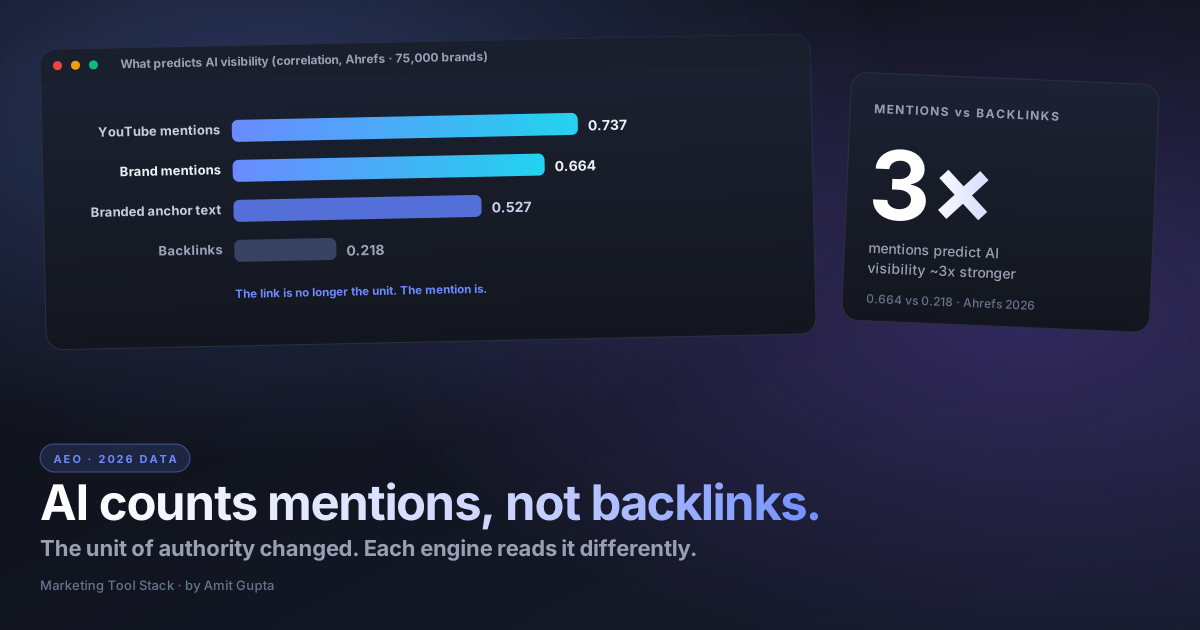
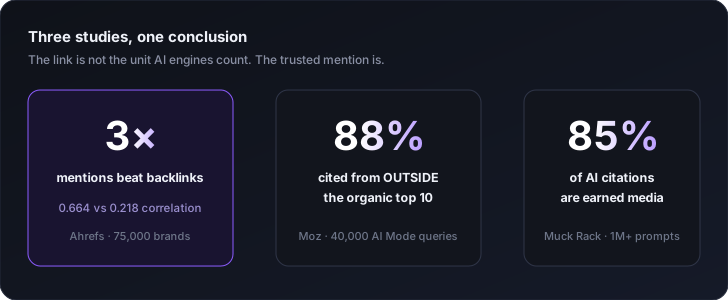
Ahrefs studied 75,000 brands and found that branded web mentions correlate with AI Overview visibility at 0.664. Backlinks correlate at 0.218. That is roughly three times stronger, and it is the clearest sign yet that the unit of authority AI counts is no longer the link.
For twenty years the backlink was the currency of trust. A link was a vote, and Google counted votes. Answer engines count something different. They count how often, and how credibly, your brand gets named across the open web.
The unit of authority moved from the link to the mention
In the same Ahrefs data, the signals rank in an order worth memorizing. YouTube mentions of a brand correlate with AI visibility at 0.737, branded web mentions at 0.664, branded anchor text at 0.527, and plain backlinks trail at 0.218. Read it top to bottom. Every signal that beats the backlink is a form of being talked about, not linked to.
Moz ran 40,000 Google AI Mode queries and found that 88% of the citations came from pages outside the organic top ten. Rank stopped being the gate. If the classic top ten no longer predicts who gets quoted, the thing that does is presence: being named on pages the model already trusts.
Muck Rack tracked more than a million AI prompts and found that about 85% of AI citations are earned media, news and editorial coverage. So the mention that moves the needle is usually not one you place yourself. It is one a journalist, a Reddit thread, or a reviewer writes about you.
Each engine builds its index differently
Here is the mistake I keep seeing. Teams treat "AI search" as one channel and optimize it once. But ChatGPT, Perplexity and Gemini fetch and cite content in ways that barely overlap. What earns a citation in one can be invisible in another. Getting cited is engine-specific.
How does ChatGPT decide what to cite?
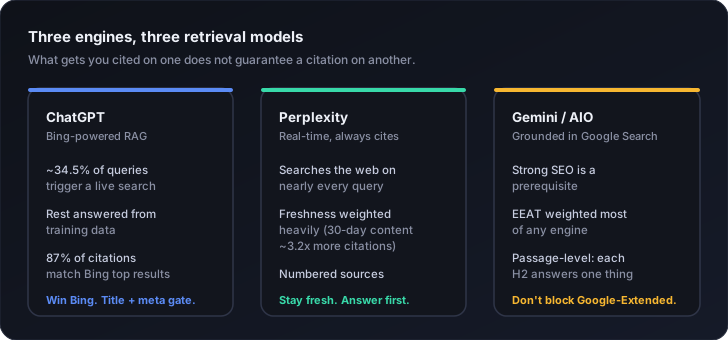
ChatGPT search is Bing-powered retrieval, so being in Bing's index is the proxy for being citable. And it reaches for the live web less than you would think. Semrush found only about 34.5% of queries triggered a live search in early 2026, down from about 46% in late 2024. Most answers come straight from training data.
When it does search, Seer Interactive found about 87% of ChatGPT and SearchGPT citations match Bing's top results. The practical read: your title and meta description gate whether the full page even gets fetched, and your Bing ranking decides whether you are in the running at all. Most teams have not looked at Bing in years. Start there.
How does Perplexity decide what to cite?
Perplexity searches the web for nearly every query, always cites numbered sources, and weights freshness heavily. It cited content less than 30 days old at about 82%, versus about 37% for older pages, and pages updated within 30 days earned roughly 3.2x more citations.
So Perplexity rewards a publishing cadence. A page you wrote once and never touched loses ground to the same page kept current. Keeping your best pages fresh is the price of staying quotable here, and recency is a ranking signal in a way it is not on classic Google.
How does Gemini decide what to cite?
Gemini and Google AI Overviews ground their citations in Google Search, so strong traditional SEO is a prerequisite, not a separate game. EEAT is weighted heavily, and extraction is passage-level: each section has to answer one sub-question on its own, or it will not get pulled.
One trap quietly makes you invisible here. Google-Extended is a separate crawler from Googlebot. Block it in robots.txt and you can still rank in Google while disappearing from Gemini entirely. Check that setting before anything else.
Backlinks are not dead. Stop measuring AEO in them.
Backlinks still matter. Traditional Google search still drives most organic traffic, and the AI engines, Gemini most of all, lean on Google rankings as a baseline trust signal. A page with no authority does not suddenly get cited because you earned a few mentions. Run both.
The shift is about measurement, not abandonment. Stop scoring your AEO program by links acquired. The unit AI actually counts is the trusted mention, so weight the effort toward earned media and being named on sources the models believe. If you want to see whether those mentions turn into answer-engine presence, that is exactly what share of AI voice measures, and I wrote the how-to in this piece on measuring AI visibility.
What to do about it this quarter
Check your robots.txt first. Confirm you are not blocking GPTBot, PerplexityBot or Google-Extended. Ranking in Google means nothing to Gemini if Google-Extended is disallowed, and this is a one-line fix most teams have never audited.
Earn mentions, not just links. Go after coverage on sources the engines already trust: editorial press, a cited Reddit answer, a YouTube review, a Quora response where your category actually lives. Muck Rack's 85% earned-media figure is your target list, and none of those need to link to you to count.
Publish first-party data with specific, attributable numbers. Models quote a named statistic far more readily than an opinion. One original benchmark with your name attached can out-earn a month of link building, because it hands every writer a number to cite back to you.
Put the direct answer in the first two sentences of every section. Gemini extracts at the passage level and Perplexity rewards a clean, quotable line, so lead with the conclusion, then support it. You can pressure-test that structure with the free SEO + AEO Content Rater, which grades answer-first sentences and question headings as a separate score from classic SEO.
Add Article and FAQ schema. It will not manufacture a citation on its own, but it labels your entities clearly, and models parse entities, not vibes. The FAQ Schema Generator builds valid markup in about a minute. Treat it as hygiene, not a growth lever.
The honest caveat on the numbers
Ahrefs measured correlation, not causation. Brands that get mentioned a lot tend to be bigger brands that also rank well, so some of that 0.664 is just brand size showing up twice. The direction is solid. The decimals are not worth carving into a forecast.
One more, because vendors love this stat. On the traffic that does arrive from AI, multiple 2026 studies find it converts higher than organic, but the exact multiple swings so wildly by source that I would not trust any single number you see quoted. Believe the direction. Ignore the precise figure.
Where this leaves you
The backlink is not worthless. It is just no longer the scoreboard. AI reads the open web looking for who is talked about and trusted, then quotes the clearest line on the most credible page it can find. That is closer to how a person decides who to believe than any link graph ever was.
So here is the one I would ask in your next planning meeting. If a journalist, a Reddit thread and a YouTube reviewer all had to describe your product tomorrow, would they reach for the same sentence you would?
Amit