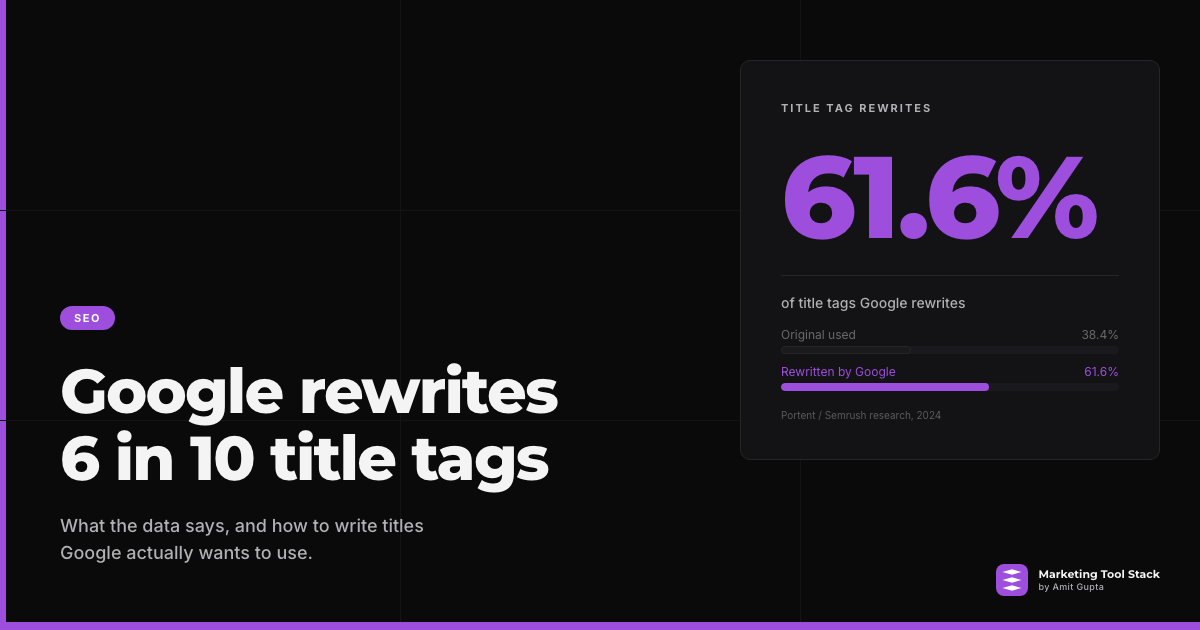

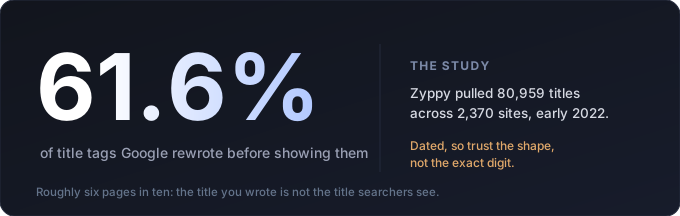
Google rewrote 61.6% of the title tags in the largest public study of the problem. Zyppy, run by Cyrus Shepard, pulled 80,959 title tags across 2,370 sites in early 2022 and found that for roughly six pages in ten, the title you wrote is not the title searchers see. The entire category of "optimize your title tag" advice skips past that number.
Here is why it matters. Most title-tag guides solve one problem: how to write a title that wins the click. They quietly assume Google will actually use that title. Six times in ten it does not. So there are two jobs hiding under one piece of advice, and almost every post conflates them. This is about the second job: writing a title Google decides to keep.
Google rewrote your title, and you probably didn't notice
"Rewrite" does not always mean a full swap. In the Zyppy data, partial substitution was the common case: Google keeps part of what you wrote and changes the rest. It strips the brand name off the end. It swaps your title for the page's H1. It pulls a different heading from further down the page. Sometimes it stitches in anchor text from links pointing at you.
You wrote the title once and moved on. The version in the results page is a Google edit you never approved, and you only find it if you go looking. Most teams never do. They track the ranking and the click, never the headline doing the work in between.
So the optimization target is not the perfect title. It is a title good enough that Google leaves it alone. Those are different things, and you can write a clickable title that still gets overwritten the second it goes live.
Four things that reliably trigger a rewrite
The Zyppy study lines up with what Google has said about its own behavior, and it points at four repeat offenders. Fix these and you remove most of the reasons Google reaches for the edit button.
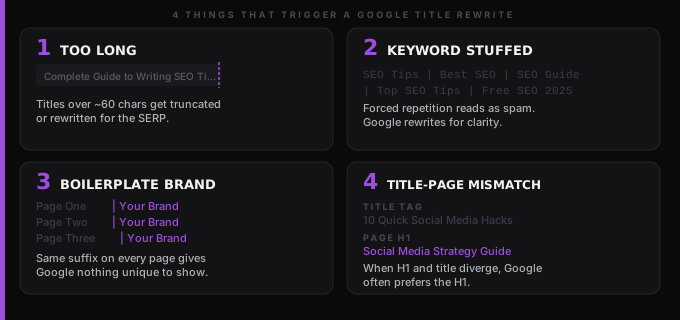
Length over the cutoff. Titles that run long get truncated or replaced. Google works in pixels, not characters, but the practical ceiling lands around 60 characters before desktop results cut you off. Write past it and you hand Google a reason to shorten the title for you, on its terms instead of yours.
Keyword stuffing and repetition. The same phrase twice, a comma-pile of near-duplicate keywords, the old "keyword | keyword | keyword" pattern. Google reads that as a title written for a crawler, not a reader, and it rewrites toward something that sounds human.
Boilerplate brand prefixes. Leading every title with your brand name, or gluing the same site name to the front of all of it, wastes the most valuable pixels on words nobody searched for. Google often strips brand boilerplate, and if you front-load it, you have given it the cut to make.
An H1 that disagrees with your title. When the title tag and the on-page H1 tell two different stories, Google tends to trust the visible page. A title-versus-H1 mismatch is an open invitation to substitute one for the other.
What Google replaces your title with
This is the part that should change how you write. When Google rewrites, it usually does not invent text. It reaches into your own page and grabs something already there.
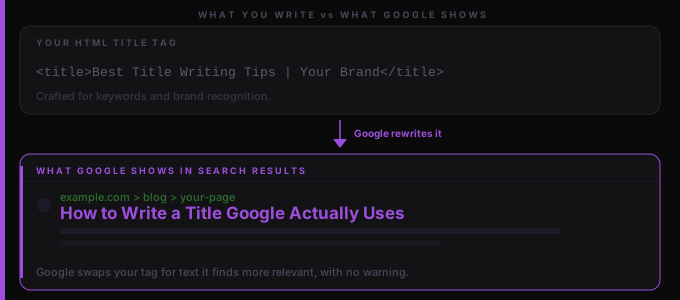
Most of the time it takes the H1. Sometimes a lower heading, an H2 or H3 that matches the query better than your title did. Sometimes it pulls the anchor text people use when they link to you. The replacement is almost always content you already control, which is the good news and the catch at once.
Here is the consequence nobody states plainly: a weak H1 produces a weak rewrite. If Google decides your title has to go and your H1 is vague, generic, or stuffed, that is the headline your searchers now see. You did not lose control of the result by skipping the title. You lost it by writing a lazy H1 and assuming Google would never read it aloud.
Writing a title Google chooses to keep
The fix is unglamorous and it is mostly about removing reasons to intervene. Four rules cover the bulk of it.
Stay under about 60 characters. Short enough to survive the desktop cutoff without truncation. If it fits clean, Google has one less reason to trim it.
Put the primary keyword near the front. Lead with the thing the page is actually about, not your brand. Front-loaded relevance is what earns the pass, and it is what carries the click in the half-second a searcher scans the page.
Match your H1, or write the title tighter than it. Since the H1 is the most common replacement, align the two. Tell the same story. If the title and the H1 agree, there is nothing for Google to reconcile, and the worst-case rewrite (the H1) is something you already vetted.
Cut the empty brand boilerplate. A site name on a navigational query earns its place. On an informational one it is dead weight Google will strip anyway. Spend the pixels on the promise instead.
The thing that makes this checkable in seconds is seeing the title the way the results page will. The Meta Tag Generator shows a live character count and a Google SERP preview, so you watch the truncation point land before you publish instead of discovering it in Search Console a month later. Paste the title, see where it cuts, see whether the keyword survives the fold. That is the whole 60-second check.
The one honest caveat
The 61.6% figure is from early 2022, and I am not going to pretend it is current. It is the best public study of title rewrites that exists, with a sample (80,959 titles, 2,370 sites) big enough to trust the shape of the finding. But the results page has changed a lot since 2022: AI Overviews, AI Mode, a more aggressive Google hand on the snippet. The exact rate has very likely moved.
What has not moved is the direction. Google rewrites titles at a high rate, it favors your visible page when it does, and the four triggers above are still the four triggers. Treat the precise percentage as dated and the mechanism as live. Anyone quoting a fresher, tidier number without a study behind it is guessing, and probably selling something.
So the work is not chasing the cleverest title. It is writing a title with no loose threads for Google to pull, and an H1 strong enough that the worst-case rewrite still does the job. Check your most important ten titles against the four rules: under sixty characters, keyword near the front, matching the H1, no empty brand prefix. The Meta Tag Generator does the count and the SERP preview in one shot, so you can run all ten before lunch.
When did you last open your top-ranking page in Search Console and check whether the title on the results page is the one you actually wrote?
Amit