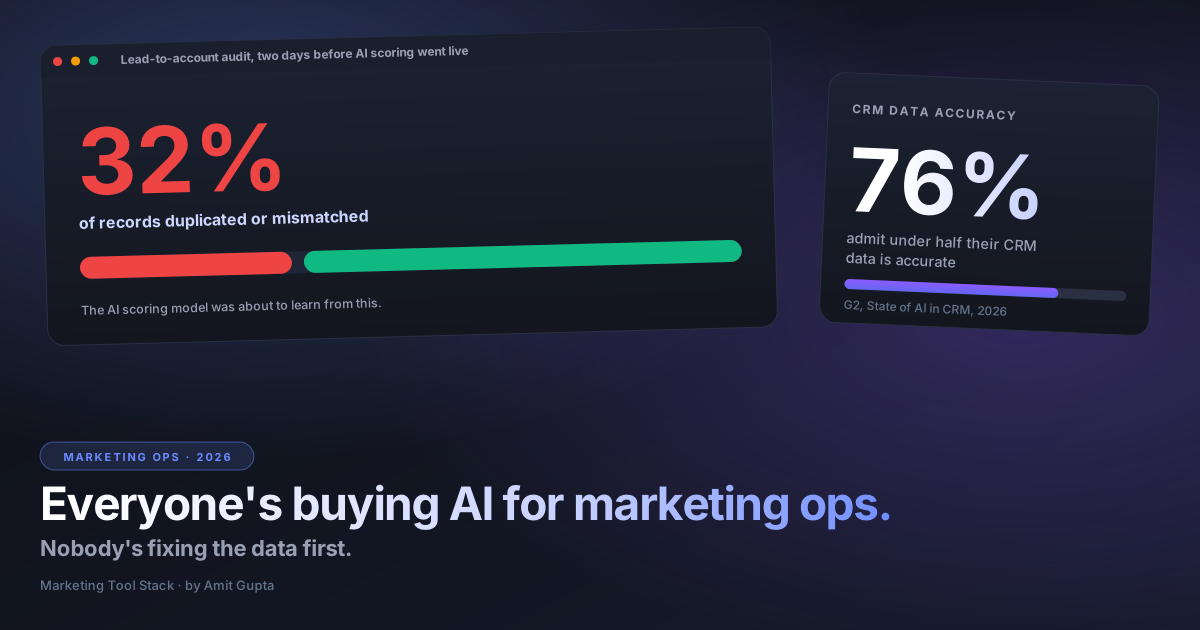

Marketing teams are about to spend more on AI than they ever have, and most of them are pointing it at data they already know is broken. Gartner has CMOs putting 15.3% of their 2026 budget into AI, with 70% calling AI leadership a critical goal. Only 30% say their operation is ready to run it.
That gap is the whole story. Here is the part nobody puts on the kickoff slide: Gartner expects organizations to abandon 60% of their AI projects through 2026 because the data underneath them was never made ready. AI in marketing ops does not fix a weak foundation. It multiplies whatever is already there, clean or dirty, at a speed no human can catch. So before the budget goes out, look at the foundation.
The foundation most teams are building on
Start with the input layer, because that is what every model reads first. In G2's 2026 research, 76% of organizations admit less than half their CRM data is accurate. Validity's 2025 survey of 602 CRM practitioners found 37% have lost revenue directly because of poor CRM data, and 45% say their CRM data isn't ready for AI at all. Gartner has pegged the running cost of poor data quality at $12.9 million a year for the average organization. That is the number sitting under every scoring model, every routing agent, and every pipeline forecast you are about to automate.
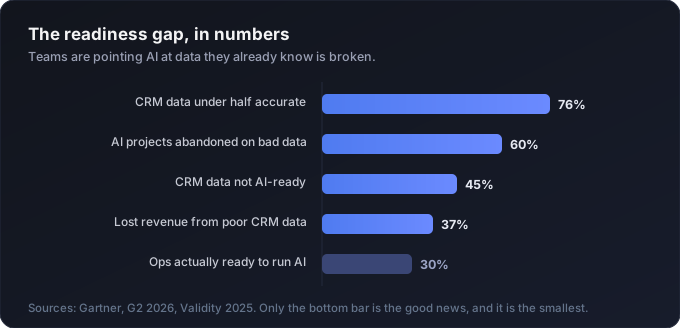
The handoff is just as leaky. LeanData's 2026 B2B report found 29% of leaders have no visibility into what happens after the marketing-to-sales handoff, 42% point to weak alignment on lead qualification, and 32% are working with duplicate or mismatched lead-to-account records. Only 26% have any real governance in place before they scale AI. Someone at Revenue Wizards put it better than most vendors will. Most companies aren't debating AI strategy right now. They're still debating whether their CRM data can be trusted.
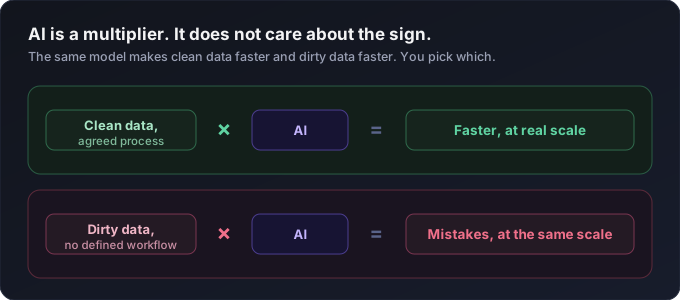
AI is a multiplier. It does not care about the sign.
Nine years inside Marketo and HubSpot taught me what that means in practice. A multiplier does not care about the sign of the number in front of it. Feed it clean data and processes your team agrees on, and it makes you faster. Feed it dirty data and workflows nobody defined, and it makes your mistakes faster, at a volume you can't manually catch. Gartner expects 30% of generative AI projects to be abandoned after proof of concept by the end of 2025, and poor data quality is the first reason it lists. The technology never fixes the foundation. It scales whatever is already there.
I saw this up close last year. A B2B SaaS team had bought AI lead scoring, named the project, and built the kickoff deck. Two days before launch, someone finally pulled the lead-to-account matching rules. 32% of the records were duplicated or mismatched, the lifecycle stages hadn't been touched since 2022, and sales and marketing still disagreed on what an MQL was. The model was about to learn all of it. The AI wasn't the problem. The data it was about to learn from was.
That sequence is common. A team skips defining lifecycle stages because there's a launch date. Automation gets built on the undefined stages. AI scoring gets layered on the automation. Now a model produces fast, confident, wrong calls at a volume no person could match. Sales blames marketing. Marketing blames the data. And the data, the real source of it, sits untouched, because fixing it was never anyone's quarterly number.
Three questions before any AI goes near your CRM
So before any team I work with aims AI at their MAP or CRM, I ask three questions. If they can't answer all three cleanly, they aren't ready, and I tell them so plainly.
First. Are your lead lifecycle stages defined, agreed on by both sales and marketing, and actually enforced inside the system? Not buried in a Confluence doc from 2021 that nobody has opened since. When the answer is no, your AI learns a process that exists on paper and nowhere else, and it scores every lead against rules your team quietly abandoned two years ago.
Second. Can you explain out loud how a lead travels from first touch to closed-won, without falling back on "it depends" or "each of our SDRs handles it their own way"? If you can't narrate that flow, neither can your system. The model fills the gaps with patterns it makes up, and you won't notice until your pipeline numbers start looking a little off in ways nobody can explain.
Third. When did you last audit your lead-to-account matching rules? If it's been longer than six months, your AI is reading from a map that no longer matches the territory. Accounts merged. Domains changed. Deals got re-parented. The rules stayed frozen while the business moved, and the model trusts that frozen map completely.
Where AI actually earns its place
None of this makes me anti-AI. I've seen it work, and when it works it pays for itself quickly. The whole thing comes down to sequence.
Once the foundation is clean, AI earns its keep fast. Scoring across 50,000 records isn't sharper than a strong ops person, but it's faster than any human will ever be, and it stays consistent at a scale that genuinely matters. Pipeline risk flagging catches patterns we miss, the small signals that a deal is slipping before the rep can feel it. And automation running on clean, rule-based processes does the boring work the same way every time, without getting tired at 5pm on a Friday. I'm not skeptical of the tools. I'm strict about the order you switch them on.
The order is the whole argument
AI doesn't reward ambition. It rewards whoever did the unglamorous work first. The 60% of projects Gartner expects to fail won't fail because the models were weak. They'll fail because the data was.
So before you sign off on the AI line item, here's the question I'd ask in the room. What did you have to fix before AI actually worked for your team? The stage definitions, the matching rules, the MQL fight nobody wanted to have? I read every answer.
Amit